
2026-2027 Off-Campus Studies Courses
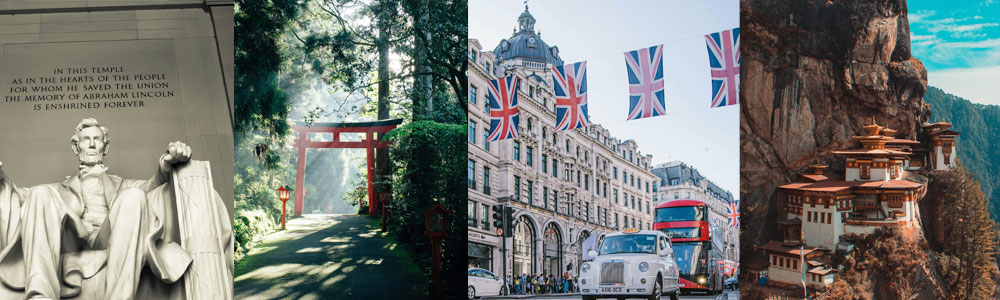
Cornell's One Course At A Time schedule provides ample opportunities to study for a block off-campus. You may either choose to travel domestically or internationally.
Ingenuity in Action funding
Apply for Ingenuity in Action funding for off-campus study via Handshake.
The priority deadline for InAct OCS applications for Cornell off-campus courses offered during the 26-27 academic year, 26-27 fall and spring semester programs, and summer '27 off-campus study programs is April 8, 2026.
Course payments
Payment information will be emailed out following your registration. For more information about off-campus course payments and policies, contact the Off-Campus Studies Office.
Block 1
REL 279: Bhutan; Paradise of the Himalayas
Professor: Steven Sacks
Destination: Bhutan
Bhutan, The Land of the Thunder Dragon, is a stunning but relatively unknown country nestled in the mountains between the regional powers of China and India, blending tradition, environmental conservation and technological development in rare and thoughtful harmony. In this academically and personally transformative trip, students will trek to temples and remote villages to encounter the history, people, environments and institutions that embody the pull and push of tradition and change in the region, while seeing the incredible but fragile Himalayan mountain cultures and ecosystems firsthand.
Block 2
POL 244: Holocaust and Human Rights in Europe
Professor: David Yamanishi
Destinations:Germany, Czechia, Poland, Bosnia & Herzegovina
Addresses the history, politics, sociology, and lived experience of the Holocaust and other significant human rights abuse in Europe, from the points of view of victims, perpetrators, and bystanders. We will work to understand why and how human rights come to be abused, how abuse affects the victims, and when and how post-conflict communities work to resolve differences and learn from periods of abuse. Visits Holocaust and other human rights sites - museums, memorials, and sites of violence - in and near European cities such as Berlin, Prague, Krakow, and Sarajevo.
STA 257: History of Statistics in the British Isles
Professor: Ann Cannon
Destination: United Kingdom
The British Isles have a rich history with respect to the field of Statistics. In this course, students will walk the path of historical statisticians both physically and in thought. Students will learn about, and critique the reasoning of, the founders of statistics, their circumstances, and their sometimes flawed reasoning, that led to the creation of major statistical concepts such as experimental design and hypothesis testing. Students will additionally learn about, and engage with, cryptography, data visualization, epidemiology, gathering of information, and the role statistics played in the eugenics movement.
Block 3
THE 349: Theater and the Arts in Chicago
Professors: Scott Olinger
Destination: Chicago
The study of American art and culture, focusing particularly on theatrical performance, opera, and dance. Typically includes backstage tours, museum and gallery visits, and workshops with local actors, designers, and other theatre artists.
Block 5
GEO 329: Geology of New Zealand
Professor: Rhawn Denniston
Destination: New Zealand
Application of geologic principles in the field to explore the geology of a New Zealand: stratigraphy, structure, geomorphology, and tectonic history. Interpretation of geologic maps. Offered on the South Island of New Zealand. Junior and senior Geology majors only.
KIN 330: Movement Across Cultures; Peru
Professor: Kristi Meyer
Destination: Peru
This course provides an immersive investigation into movement in the life and culture of Peru. We will explore the intersections of various aspects of movement (exercise, sports, physical activity, cultural expression) with Peruvian history, culture, education, wellness, tourism, and the environment. Specific research topics may include environmental impacts of movement-based tourism, education of movement within and outside of the Peruvian school system, the meaning and quantification of movement during cultural festivals, an analysis of physical activity and wellness in Peruvian culture, and a comparison of the history of movement between the indigenous Incan tribes and present-day communities. A significant portion of the course (three weeks) will be conducted in Lima and Cusco, Peru. Field activities will include hiking at high altitude, including backpacking to Machu Picchu on the Inca Trail, exploring historic sites, community engagement with local residents and teachers, and experiencing the local culture.
Block 6
EDU 270: Comparative Education in Belize
Professor: Jill Heinrich
Destinations: Belize
EDU 270 Comparative Education in Belize is an off-campus course that allows students to teach in local schools in San Pedro Town on the island of Ambergris Caye in Belize. Interdisciplinary in nature, the course includes sociological, anthropological and historical study of the Belizean people, their school system and their culture. Students will gain familiarity with Hispanic, Creole, Mayan, Garifuna and Mestizo cultures and complete a qualitative and ethnographic research project born of their off-campus experience. Course is open to education majors and non-education majors but priority is given to students who have completed two of the 200 level education courses.
Block 7
SOC 249: Traditional Culture and Contemporary Issues in Japan
Professor: Tori BarnesBrus
Destination: Japan
This course examines the interconnections between Japanese cultural traditions and contemporary social issues. We will explore the enduring historical and cultural foundations and values as well as contemporary issues that inform everyday life in Japan, such as health and wellbeing and gender roles.
While in Japan, class members will participate in a variety of activities and discussions; will complete field excursions to historical, cultural, educational, and religious settings; and will read materials relevant to these themes. Students will also explore contemporary culture by observing and interacting with Japanese citizens and hearing from guest lecturers. The course includes travel to and within the Kyoto-Osaka (Kansai), Kanazawa, Hiroshima, and Tokyo (Kanto) regions of Japan.
The primary “texts” for the course come from the cities of Kyoto and Tokyo and their surrounding communities. These “texts” could include museums, gardens, showcases of technology (household items and other technologies), traditional cultural performances, traditional Japanese arts (e.g., tea ceremony, ikebana), popular culture (e.g., karaoke, manga,), religious settings and observances (e.g. shrines, temples), public service agencies, universities, and the everyday cultures of Japanese life.
Block 8
POL 254: American Political Institutions
Professor: Megan Goldberg
Destination: Washington D.C.
In this course, we will explore the major institutions of the US federal government, with a special focus on the Presidency and Congress. At its heart, this course is about representation. The course will begin by asking why we have a representative democracy at all, and what we really mean by representation. Then, we will turn our attention to the ways in which these particular political institutions help or harm the process of representing the views of citizens in policymaking. We'll cover a variety of historical and contemporary theories about how lawmakers represent us and how institutions interact with one another to either improve representation and accountability. You will conduct your own in depth research project on a particular member of Congress to explain the connection (or lack thereof!) between the member and their district. In this course, we'll turn a critical eye to these institutions - and the people in them - to ask if our representative government is working well. For the last eight days of the course, we will be in Washington, DC observing Congressional committees in action, speaking with staffers, and learning from practitioners.