|
||||||||||||
|
||||||||||||
|
|||||||||||||||||||||||
Masterpieces of Greek and Roman Theater |
||||||||||
|
Comedy: Greece and Rome to Hollywood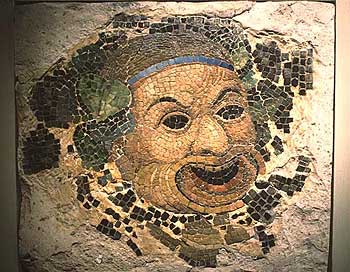 Comic mask, Roman mosaic, Indianapolis Museum of Art Instructors: Dr. John Gruber-Miller, College Hall 312, Ext. x4326; email: jgruber-miller@cornellcollege.edu Laura Farmer, Writing Studio Director, 124 Cole Library; phone: x4509; email: lfarmer@cornellcollege.edu Jennifer Rouse, Arts and Humanities Consulting Librarian, 307 Cole Library; phone: x4466; email: jrouse@cornellcollege.edu Brooke Bergantzel, Instructional Technology Librarian, Cole Library, phone x4125; email: bbergantzel@cornellcollege.edu Class Hours: M-F 9:00-11:15; 1:00-3:00 some afternoons (see daily schedule) Office Hours: M W F 11:15 a.m.-12 noon, and by appointment Required Texts:
Goals of the Course
Course FormatDiscussion, oral and written reports, in-class writing, small group collaboration, workshop, conference. Throughout the course, you will learn to share and express ideas clearly and effectively, to collaborate, to critique others' ideas, and to give and receive criticism about one's own ideas and writing. RequirementsClass preparation and attendance: For you to get the most out of the course, it is crucial that you come to every class session well prepared. Being well-prepared means not only having read the material, but also having spent time reflecting on it. It also means being ready to participate in class discussion by asking questions, offering opinions, making observations, and trying out arguments. As you prepare for class, it is a good idea to write marginal notes in your text to remind you of good jokes, ironic comments, historical background, recurring themes, and questions you have about the text. It is also very helpful to get together with others in the class and read the plays aloud to try to capture the humor, understand the action, get into the different characters, etc. Class discussion: I hope to foster an atmosphere in which students are free to speak their minds. We all (myself included) bring different backgrounds, preparation, theoretical perspectives, and values to this course. We all will learn from many sources: our common readings, each other, our discussions, and our research. It is, therefore, crucial to the success of the course that everyone show respect and courtesy to everyone else in the class, and a willingness to help each other learn and approach this material from new perspectives. Comedy Terms Jeopardy: The project is to write (in two paragraphs) a definition of your term in your own words using multiple sources (paragraph 1). Then give at least one example from Aristophanes, Chaplin, or Roman comedy (paragraph 2). Using the library course guide that Jen showed us yesterday, please consult at least three different sources for a definition and cite the sources that you consulted. Email these definitions to me by the first Thursday at 9:00 a.m. Then after you have had a chance to study everyone's entries, we'll play Jeopardy the following Monday. Oral report: Once during the course, you will give an oral report illustrating a particular theoretical approach to comedy. You may present individually or with a partner. All reports should be accompanied by a handout to be given to the rest of the class, outlining the author's argument and presenting examples from the comedies we have read or seen. It will help you to be more focused when you give your report, and it will provide an outline for others to take notes on as they listen. Here is a Rubric for Oral Presentations. Perform a scene: Once during the course, you will collaborate to perform a scene or two from one of our plays. By looking closely at the scene(s) to be performed and reading it carefully to determine what internal cues are available to determine stage directions, you and your collaborators will discover how the scene should be played out. After the performance, each member of the group must be prepared to explain his/her decisions both orally to the class. Three Papers/Projects: Of the three papers/projects, at least one will involve a comparison of some aspect of an ancient and modern comedy; at least one will utilize a theoretical perspective to come to a better appreciation of one of the texts/films. For one of the three papers, you may do a right-brain, creative project (i.e. designing costumes for a play, rewriting a scene or two in modern idiom, writing the ending to one of Menander's fragmentary plays, presenting production notes for a modern production of one of the plays, discussing how a filmed version of a scene or two would be different from a theatrical production). Papers/projects are due each Friday of the block at 5 p.m. I have suggested some possible paper and project topics for your benefit, but feel free to develop your own. Aspects of Comedy Project: In order to understand the different aspect of comedy more thoroughly, both in theater and in film, pairs of students will choose a film, TV show, or a play from the Renaissance to the present, and explore how it addresses the topics below:
The main question to ask: which ancient approach to comedy (represented by Aristophanes, Menander, Plautus, or Terence and the films associated with that portion of the course) does your work appear to be most similar to? The project is both descriptive and critical. By descriptive, I mean that you attempt to create a kind of database of examples from the plays and films we have watched that pertain to the work you have chosen. By critical, I mean that you will define each of these categories and attempt to look for patterns in your work that parallels plays and films that we have viewed in class. Even better if you can explain why your work does not fall into the approaches of other authors. This second part is harder at first, but hopefully will become easier as the term progresses and you develop a broader understanding of comedy. Critique of another group's website: In order to see what other groups are working on and to help each other improve their projects, each week I will ask each group to comment on another group's website. Here's how: First, open up the course project webpage and find the webpage of the project that you will be commenting on. The first time, each group will critique the group that follows them on the left navbar. The second time, each group will critique the group that immediately precedes their group. Second, open the document website critique and write your comments about the website you are viewing as answers to the questions there. Third, when you have finished writing your comments, save the website critique with a new name. Then compose an email that you will send to yourselves, the members of the group you are commenting on, and me. Insert the website critique as an attachment and email it to everyone. Please be sure to sign the names of those who contributed to the critique. The first critique is due the 3rd Saturday at noon. The second is due the 4th Tuesday at 3:00 p.m. When you are done, go ahead and look at others' websites and/or read the comments other groups made about your pages. GradingThree major components will determine your grade:
PoliciesAttendance: Since our class format is based primarily on discussion and workshops, it is essential that you come to class every day, prepared and ready to participate actively. Any unexcused absence after one missed class period will harm your final grade. If you must miss class, please inform me ahead of time if at all possible. If you have a fever and other symptoms of the flu, please do not come to class until you have been fever-free for 24 hours. Drafts of Papers: Learning how to revise papers is an important element of becoming a successful writer, and conferences are an important element in honing your writing skills. The failure to submit a full-length draft when due will automatically result in a grade of C or below for that particular paper. Deadlines: It is very important that you keep up with assignments as they are due; falling behind will have a negative impact on your performance. Without either prior approval or evidence of a serious emergency, research and papers may not be accepted, paper workshops and presentations will not be rescheduled, and other late work may be penalized. Failure to complete an assignment is grounds for a failing grade in this course. Academic Integrity: According to the Cornell College Student Handbook, plagiarism is "is the act of taking the work of another and presenting it as one's own, without acknowledgement of the original source." In other words, using others' ideas, words, even sentence structure, without crediting them is a serious academic offense. Plagiarism also includes writing a paper for another person, borrowing or buying an essay and submitting it as your own, or paraphrasing an article but forgetting to document it. Click here for Cornell's policy on Academic Honesty. Accomodations for different learning styles: Cornell College is committed to providing equal educational opportunities to all students. If you have a documented learning disability and will need any accommodation in this course, you must request the accommodation(s) from me as early as possible and no later than the third day of the term. Additional information about the policies and procedures for accommodation of learning disabilities is available on the Cornell web site at Academic Honesty Policies Site
|
|||||||||
|
||||||||||||
|
||||||||||||


